Showing posts with label bees. Show all posts

Sunday, June 24, 2012

Garden Alive!

"She sat down in a weed patch, her elbows on her knees, and kept her eyes on the small sterious world of the ground. In the shade and sun of grass blade forests, small living things had their metropolis."   
- Nancy Price
When I really look at, I mean really PAY ATTENTION TO, the creatures in my yard, I am astonished. I equate the feeling to finding myself in a dark, remote area and observing hundreds of thousands of stars glowing in the night sky. I ask myself: Is there all of a sudden a huge increase in the number of stars up there, or were they always there and I just didn't see them, or pay attention to them?


When I really began to look at, I mean really PAY ATTENTION TO, the creatures in my small, urban yard, this is what I have observed:
Squirrels, and whole lot of them
Carpenter bees
Bumblebees 
Honeybees
Ants of many sorts
Crickets
Leafminers
Praying mantids
Rabbits 
 Lady bugs and their larvae
Cardinals
Moths
Butterflies
Grasshoppers
 Mites of several sorts
 Leafhoppers
Flies of many sorts
Earwigs
Raccoons
Slugs
Robins
Aphids
Blue jays
Wasps
 June beetles
Japanese beetles
Pill bugs
Wireworms
Dragonflies
Starlings
Chipmunks
Wrens
Woodpeckers
Mosquitos
Gnats
Garden webworms
Goldfinches
Nightcrawlers
Millipedes
Cabbage worms
Spiders of many sorts
Soldier bugs
Neighborhood cats
White-breasted nuthatches

My garden is alive! I have personally seen every one of the above in the last three months--that's an ACTIVE, garden party kind of yard.


Is this good, bad, normal? I don't know, but it is astonishing to me.

Humans are physically larger than any one creature on the list, yet we are grossly outnumbered. That fact is a bit unsettling to me--several month's worth of work in the garden could be completely obliterated in a few buggy nights ...  if not for the awesome balance of nature.

When have you last paid attention to what's alive in your yard?

Thursday, May 17, 2012

Wood-Boring Bees!

Bumblees are fascinating creatures. Their amazingly loud buzz and way of hovering is something out of a science fiction movie. I was enjoying a small group of them in my yard (from a distance) until I needed to work in their area (up close), and I started to notice some strange behavior around the eaves of my garage.

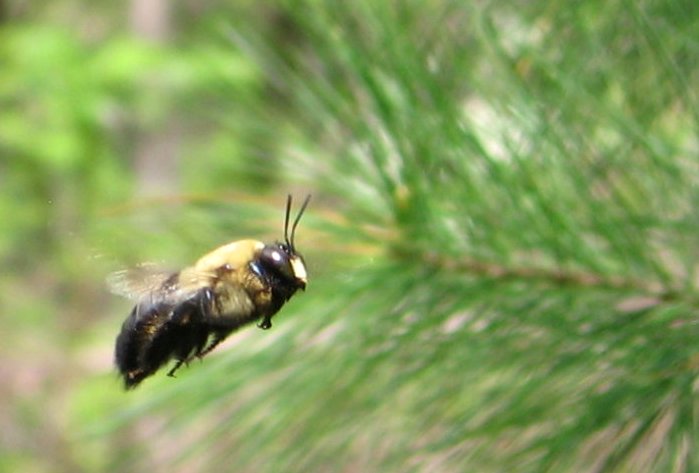
Turns out what I have in my yard are not actually bumblebees but carpenter bees. Their shiny abdomens set them apart from bumblebees, which are completely covered in dense hair. Carpenter bees use their mandibles to bore holes in wood, where Miss Queen Bee lays her eggs.


I recall seeing one guy buzzing around the entire garage for a few days. I've learned that he was likely a scout bee, looking for just the right spot for his Queen to lay her eggs. More bees came. They would chase and tangle up with each other, dive bomb me, and then repeatedly return to hang out under the eaves. Research tells me they were anxiously waiting for the arrival of Her Highness.

Perfectly round holes in the eaves of my garage, compliments of the carpenter bee.

I believe that She has now arrived. The trumpets have sounded. Yesterday, the frenetic buzzing about moslty  settled down, so I took a closer look-see. What I found are 1/2-inch holes in my wood (no drill bit used here). Carpenter bees tend to do this in sheltered areas, and into bare, unprotected wood. How gracious of us--we've provided just that for them.

The question now is: Can I live peacefully with these guys? The males, though aggressive in their protection of their territory, cannot sting. Females rarely do, unless provoked. Males have white or white faces, and females have black faces (I need to remember that). They are phenomenal pollinators, and I will need that in the coming weeks. I'll be planting watermelon, cabbage, Brussels, and kale in this area.

More bee holes, above planting beds 2 and 3.

But what about the damage to my garage? Are the bees done boring for the season? If so, perhaps I'll let them be for now, and treat the wood in the fall, hoping they find somewhere else to nest. Reportedly, rubbing or spraying almond oil on the bare wood detracts them. I've also read that the holes can be filled with a small ball of foil and caulked. Do you have any other, chemical-free suggestions?

I'm heading out now to work the soil directly under this area. Black-faced Queen Bee, oh hear me: Please keep your distance. I greatly respect you, I do, and your stinger bee butt.